Blog
Yu-Gi-Oh! Deck Building Basics for New Duelists


Learning the fundamentals of Yu-Gi-Oh deck building is essential for new duelists who want to create competitive, consistent, and enjoyable decks. Whether you’re assembling your first deck or upgrading an existing Structure Deck, understanding card ratios, deck construction rules, and effective strategies can help you improve your gameplay.
A well-designed Yu-Gi-Oh! deck combines Monsters, Spells, and Traps that work together toward a clear strategy. Choosing the right cards, maintaining a consistent Main Deck, and preparing an effective Extra Deck can make your deck more reliable.
In this beginner-friendly guide, we’ll explain Yu-Gi-Oh deck building basics, recommended card ratios, important deck construction rules, and practical strategies to help you build your first deck with confidence.
Quick summary: keep your Main Deck at 40 cards, play 3 copies of your most important cards, build around one strategy, and include cards that stop your opponent’s plays.
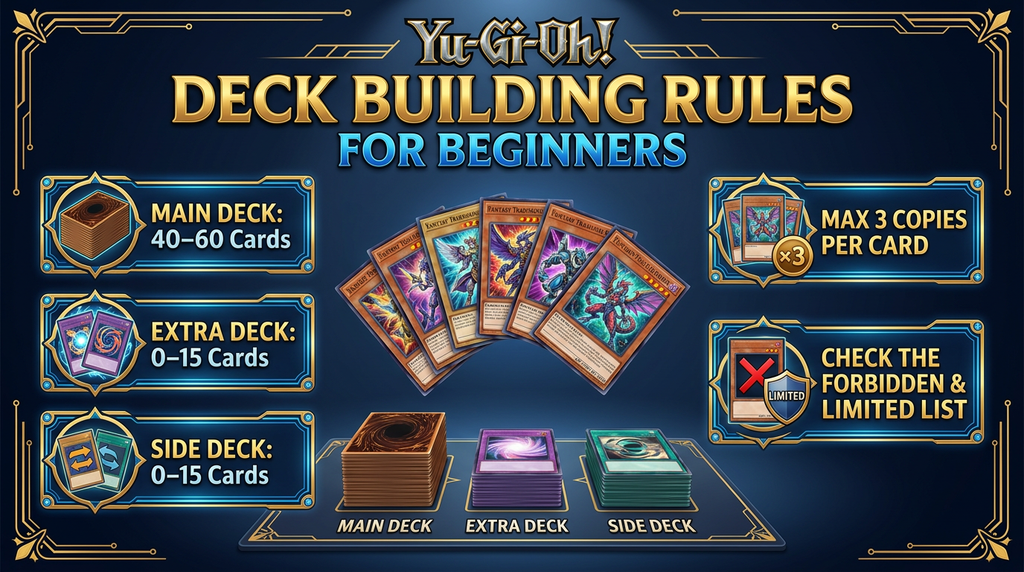
Yu-Gi-Oh Deck Building Rules for Beginners
| Part | Size | What goes in it |
|---|---|---|
| Main Deck | 40 to 60 cards | The Monsters, Spells and Traps you draw from |
| Extra Deck | 0 to 15 cards | Fusion, Synchro, Xyz and Link Monsters |
| Side Deck | 0 to 15 cards | Cards you swap in between games of a match |
You can play up to 3 copies of a card across all three decks, unless the official Forbidden & Limited List restricts it to 0 (Forbidden), 1 (Limited) or 2 (Semi-Limited). The list is updated several times a year, so check the current version before a tournament.
Why 40 cards is almost always right
Every extra card makes it less likely you’ll draw your best ones. With 3 copies of a card in a 40-card deck, you’ll open at least one in your 5-card starting hand about 34% of the time. In a 60-card deck, that drops to about 23%.
That’s why nearly every competitive deck plays exactly 40. Only go higher if your strategy truly needs it.
The three building blocks
Successful Yu-Gi-Oh deck building starts with choosing a clear strategy and selecting cards that support it. A consistent deck combines a reliable engine, useful hand traps, and cards that help overcome opposing strategies. Understanding how these components work together can help beginners create more effective decks without including unnecessary cards.
1. Your engine
The engine is the group of cards that makes your strategy work, usually cards from one archetype that search for, summon and support each other. Starters begin your combo on their own; extenders let you keep going if a play gets stopped. Play your key engine cards at 3 copies.
2. Hand traps and interruptions
Hand traps are cards you use from your hand during your opponent’s turn to disrupt their plays. Well-known examples include Ash Blossom & Joyous Spring, Effect Veiler and Infinite Impermanence. Most competitive decks play several.
3. Board breakers
When you go second, your opponent will often have a strong board waiting. Cards such as Evenly Matched and Dark Ruler No More help you break through. Always check these against the current Forbidden & Limited List.
A simple starting template
| Category | Cards | Notes |
|---|---|---|
| Engine (starters and extenders) | 18 to 22 | Your archetype’s core cards, mostly at 3 copies |
| Hand traps and interruptions | 8 to 12 | Stop your opponent’s turn |
| Board breakers and flexible Spells | 4 to 8 | Clear strong boards when going second |
| Total Main Deck | 40 |
Treat this as a starting point. The right balance depends on your deck and the opponents you face.
Building your Extra Deck
Your Extra Deck doesn’t take up space in your hand, so use all 15 slots. Prioritise the monsters your combos actually summon, then add flexible Link and Xyz Monsters that work with many decks.
Step by step: your first deck
- Choose one strategy you enjoy. A recent Structure Deck is the easiest starting point.
- Buy two or three copies of that Structure Deck to get full sets of its key cards, or buy the missing cards as singles.
- Cut the weakest cards until you reach 40.
- Add hand traps and board breakers that fit your budget.
- Fill your Extra Deck with the monsters your combos use.
- Draw and play out at least 10 practice hands on your own, then play real games and adjust.
- Build a Side Deck once you know which matchups give you trouble.
Common mistakes to avoid
- Mixing several strategies in one deck instead of committing to one.
- Playing only 1 copy of the cards your deck depends on.
- Going over 40 cards \”just in case\”.
- Leaving out hand traps and board breakers, so you can’t interact with your opponent.
- Forgetting to check the latest Forbidden & Limited List.
Frequently asked questions
How many monsters should a Yu-Gi-Oh! deck have?
There’s no fixed number. Modern decks are built around what the strategy needs, so count your starters rather than your monsters.
Should I start with a Structure Deck?
Yes. Structure Decks are affordable, ready to play and a reliable base to upgrade over time.
Can I use cards from old sets?
Yes. Any officially released card is legal in the standard Advanced format unless the Forbidden & Limited List restricts it.
Ready to build? Browse our Yu-Gi-Oh! products for Structure Decks, booster boxes and more.