Blog
Yu-Gi-Oh! Card Rarities Explained: From Common to Secret Rare

Understanding Yu-Gi-Oh card rarities is essential for collectors, trading card enthusiasts, and beginners who want to recognize the differences between Common, Rare, Super Rare, Ultra Rare, and Secret Rare cards.
When opening a Yu-Gi-Oh! booster pack, you may notice that some cards have holographic artwork, foil lettering, or distinctive patterns, while others have a standard finish. These visual differences can help identify a card’s rarity, although finishes may vary between sets and special releases.
This guide explains the main Yu-Gi-Oh card rarities, how to recognize their characteristics, and what collectors should consider when evaluating cards.
Open any Yu-Gi-Oh! booster pack and you’ll notice that some cards shine and some don’t. The finish of a card’s name, artwork and border tells you its rarity, and rarity has a big effect on how collectible a card is. Here’s a clear guide to the main rarities and how to recognise each one.
Good to know: rarity changes how a card looks, not how it plays. A Common and a Secret Rare version of the same card have exactly the same effect in a duel.
Understanding the Main Yu-Gi-Oh Card Rarities
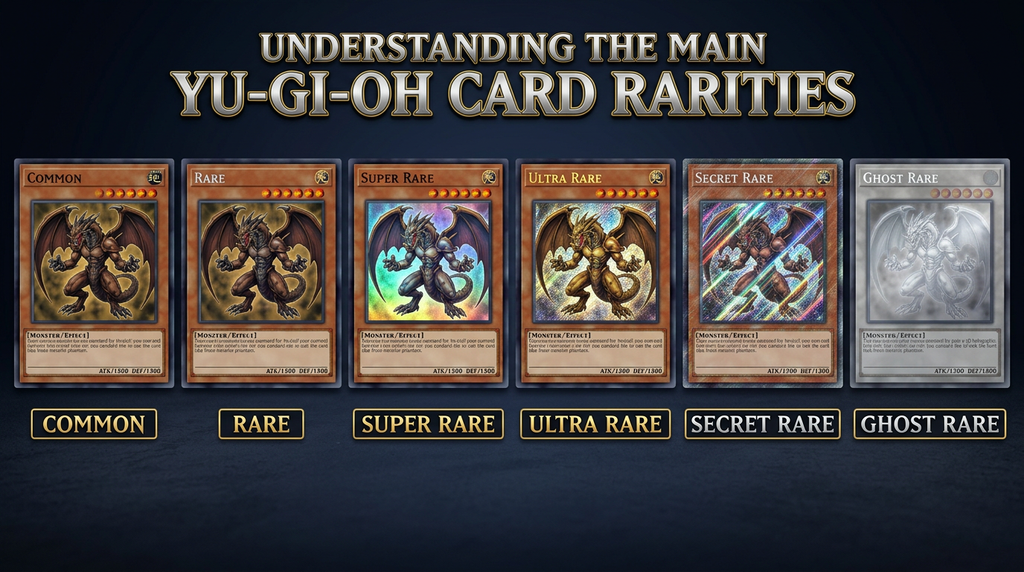
| Rarity | How to recognise it |
|---|---|
| Common | Plain card name and non-foil artwork |
| Rare | Silver foil card name; artwork is not foil |
| Super Rare | Foil artwork; card name is regular (not foil) |
| Ultra Rare | Foil artwork and a gold foil card name |
| Secret Rare | Rainbow or diagonal-pattern foil across the artwork, with a rainbow-tinted name |
| Ultimate Rare | Embossed, raised details on the artwork, border and name |
| Ghost Rare | Pale, almost 3D holographic artwork with a silvery look |
| Starlight Rare | Foil across the whole card, including the text box and border, with a distinctive linear pattern |
| Collector’s Rare | A textured, full-card foil effect, often on popular cards |
Not every set includes every rarity. Each set has its own rarity list, and special products such as rarity collections may use extra rarities like Quarter Century Secret Rare or Platinum Secret Rare.
Why rarity matters
- Pull rates: higher rarities appear far less often, so they’re harder to find
- Value: a popular card in a high rarity can be worth many times its Common version
- Collecting goals: many collectors chase a full set in one rarity, or a favourite card in its rarest form
- Showing off: plenty of duelists like to “bling out” their deck with high-rarity versions
Other things to check on a card
Set code
Below the artwork on the right is a code such as ABCD-EN001. It tells you which set the card is from and its number in that set.
1st Edition
Cards from the first print run of a set say 1st Edition under the artwork. Collectors often prefer them.
Authenticity hologram
Genuine cards have a small authentication hologram in the bottom-right corner. A missing, flat or poorly printed hologram is a warning sign.
Tips for new collectors
When comparing Yu-Gi-Oh card rarities, always check the card’s set code and printing before estimating its rarity or value. Two cards featuring the same monster can have different finishes, release histories, and collector demand. Examine the artwork, foil lettering, texture, and condition carefully, and compare your findings with reliable set information.
Collectors should also consider whether a card comes from a standard booster release, promotional product, or special collection. Some rarities are exclusive to particular products, while others appear across multiple expansions.
For long-term collection care, store valuable cards in protective sleeves, avoid excessive handling, and keep them away from direct sunlight and moisture.
- Store valuable cards in sleeves and toploaders straight away
- Learn the rarity list of a set before you buy, so you know what you’re chasing
- Buy sealed product from trusted sellers to avoid searched or resealed packs
- Keep high-rarity cards away from sunlight to avoid fading
Start your collection. Browse our sealed Yu-Gi-Oh! products.